

Sparaxis villosa | Synnotia villosa | Blue-cap flower | Hairy Satinflower | South African geophyte | 30-100 seeds




Discover the understated beauty of Sparaxis villosa, an unusual South African geophyte with distinctive, delicately patterned flowers.
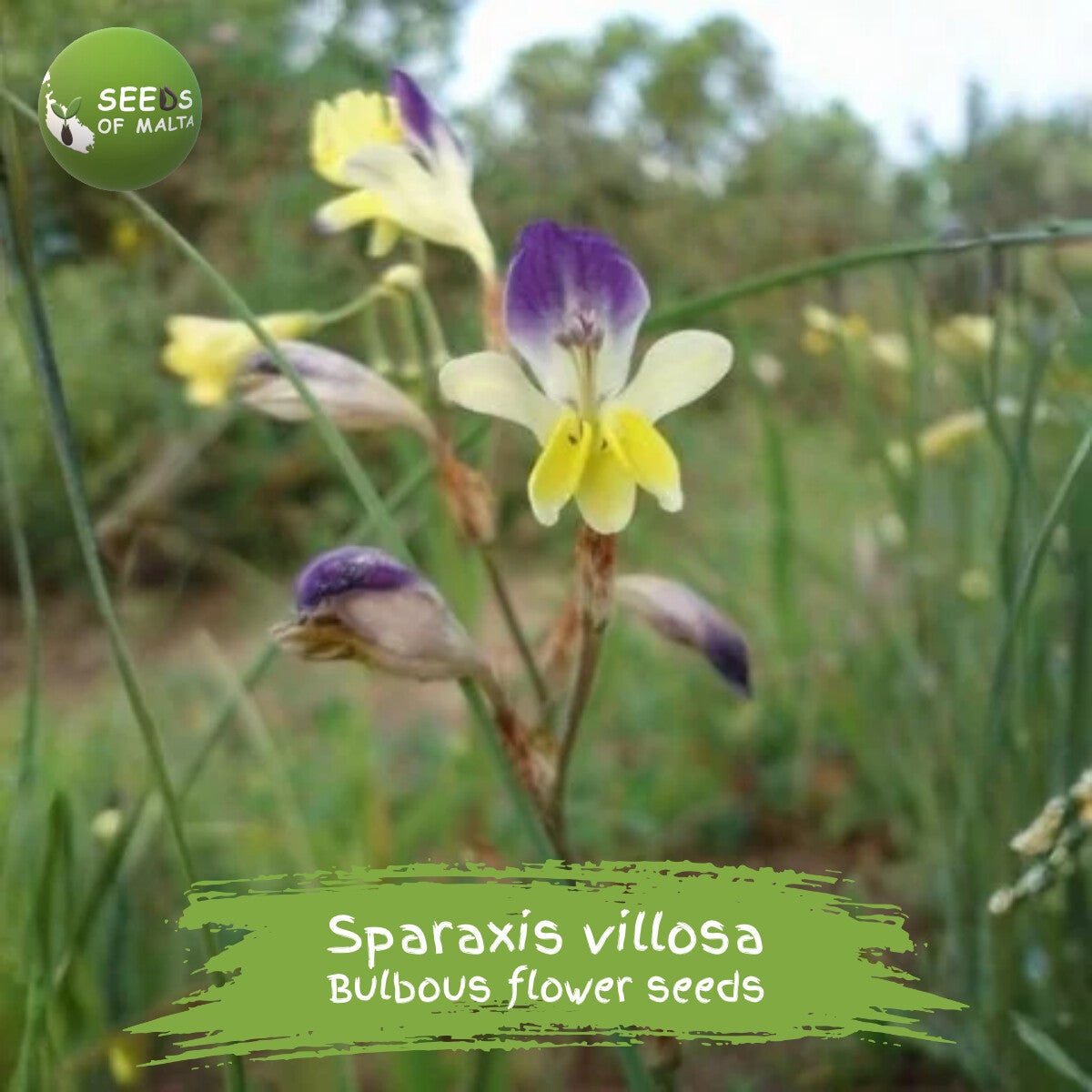
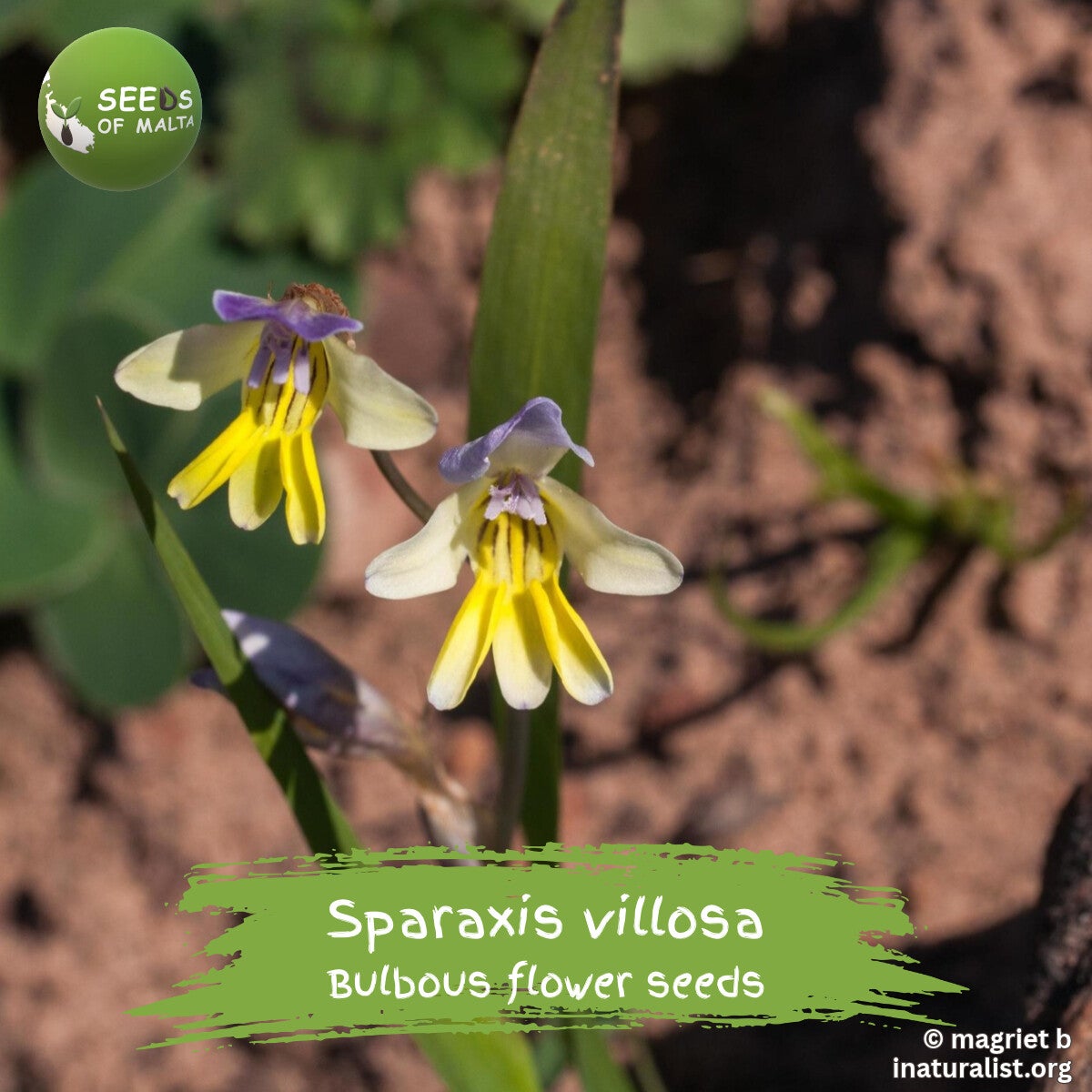
Also known by its former botanical name Synnotia villosa, this charming species produces small, asymmetrical flowers in creamy-yellow tones. The upper petal is particularly distinctive, with a violet-purple flush, while the lower petals are deep yellow, fading to cream towards their tips.
Native to the southwestern Cape of South Africa, Sparaxis villosa grows naturally in renosterveld vegetation and on clay and granite-derived slopes. Its unusual flower structure and distinctive underground corm make it an interesting addition to collections of South African bulbs and botanical species.
A lovely choice for collectors of unusual Iridaceae, specialist geophytes and lesser-known South African wildflowers.
Botanical Information
Botanical name: Sparaxis villosa (Burm.f.) Goldblatt
Family: Iridaceae
Common name: Hairy Satinflower
Former botanical name: Synnotia villosa
Other synonyms: Gladiolus villosus, Sparaxis bicolor
Origin: Southwestern Cape, South Africa
Plant type: Cormous perennial geophyte
Height: Approximately 15–35 cm
Flower colour: Creamy yellow, with a violet-purple upper petal and deep yellow lower petals
Flowering season: Late winter to early spring in its native habitat
Growth cycle: Winter-growing, summer-dormant
Interesting Facts
• Sparaxis villosa has one of the most unusual corm structures in the genus. Its outer covering consists of coarse, hard fibres that become thickened into distinctive claw-like ridges.
• Its flowers are bilaterally symmetrical rather than the familiar star-shaped form seen in many other Sparaxis species.
• The upper petal is larger and slightly hooded, with a violet-purple flush, contrasting with the yellow lower petals.
• It occurs naturally across a relatively broad area of the southwestern Cape, including the Cape Peninsula, Tulbagh, Piketberg and Citrusdal.
• Despite its delicate appearance, it is adapted to the seasonal conditions of the South African winter-rainfall region.
• Its conservation status is Least Concern (LC), according to the SANBI botanical monograph.
Growing Instructions
Sparaxis villosa is a winter-growing geophyte that naturally grows during the rainy season and becomes dormant during the dry summer months.
Sowing:
1. Sow seeds in autumn if you live in a frost-free climate, when temperatures begin to cool.
If you live in a temperate climate with cold winters (e.g. Germany, the UK or northern Europe), sow in early spring instead, when daytime temperatures reach approximately 20–25°C and the difference between daytime and nighttime temperatures is around 12°C.
2. Use a well-draining seed compost mixed with coarse sand or fine grit.
3. Sow approximately 3–5 mm deep and cover lightly.
4. Water gently after sowing.
Germination:
• Keep the growing medium lightly moist during the active growing period.
• Place in a bright position with good air circulation.
• Avoid waterlogging.
• Germination time can vary depending on temperature and seed freshness.
Growing on:
• Provide plenty of light and good drainage.
• Water during autumn, winter and spring while the plant is actively growing.
• Reduce watering as the foliage begins to die back.
• Keep the corms dry during summer dormancy.
• Allow young plants time to develop their corms before expecting flowering.
Sparaxis species can take a few growing seasons to reach flowering size, so patience is rewarded!
Shipping
Shipping worldwide (check local import regulations). Seeds are packaged to ensure freshness.
🌿 Don't forget to follow us on Facebook and Instagram – find the links in our profile.
Thank you for your interest in Seeds of Malta!