

Lachenalia Viridiflora | Azure Viooltjie | Green-Flowered Cape Cowslip | South African Geophyte | Rare Turquose Flower | 10-50 seeds
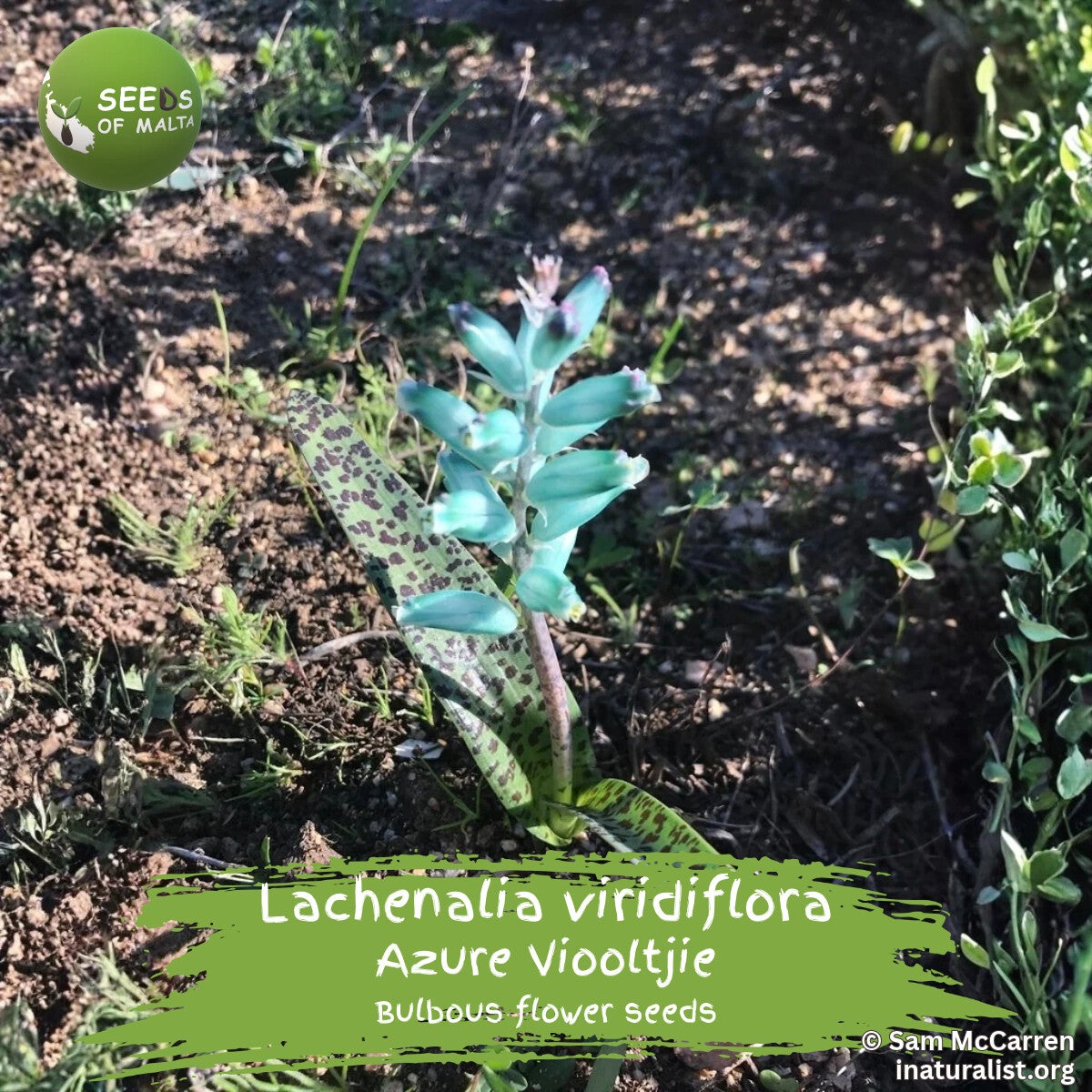


A little jewel from South Africa! 🌿
Lachenalia viridiflora is a fascinating winter-growing bulbous plant, admired for its extraordinary turquoise-green flowers. Its unusual colour makes it stand out from almost any other flowering bulb.
Native to the Western Cape of South Africa, this compact species produces two attractive lance-shaped leaves, sometimes decorated with dark markings, followed by upright clusters of tubular turquoise or blue-green flowers with delicate whitish tips.
Growing approximately 8–20 cm tall, it is particularly suited to container cultivation and specialist bulb collections.
BOTANICAL INFORMATION
Botanical name: Lachenalia viridiflora W.F.Barker
Common name: Green-flowered Cape Cowslip
Family: Asparagaceae
Plant type: Bulbous perennial geophyte
Origin: Western Cape, South Africa
Height: Approximately 8–20 cm
Flower colour: Turquoise, blue-green to greenish turquoise, with pale tips
Flowering season: Late autumn to winter
Growth cycle: Winter-growing, summer-dormant
INTERESTING FACTS
💚 One of the most unusual features of this species is its striking turquoise-green flower colour, a relatively uncommon colour among flowering plants.
🌱 The species was discovered in the 1960s and formally described in 1972 by botanist W.F. Barker.
🐦 In its natural habitat, its flowers are pollinated by sunbirds, which reach into the tubular blooms to feed on nectar.
🌸 Despite its delicate appearance, it can be successfully grown in pots when its seasonal growth cycle is respected.
GROWING AND SOWING INSTRUCTIONS
Sowing time:
Sow in autumn if you live in a frost-free climate, when temperatures begin to cool.
If you live in a temperate climate with cold winters, such as Germany, the UK or northern Europe, sow in early spring instead, when daytime temperatures reach approximately 20–25°C and the difference between daytime and nighttime temperatures is around 12°C.
Sowing method:
• Use a well-draining, slightly acidic seed-starting medium.
• Sow seeds approximately 3–4 mm deep.
• Avoid sowing too densely to reduce the risk of fungal problems.
• Keep the medium lightly moist, watering gently with a fine spray.
• Fresh seeds can germinate in approximately 2–3 weeks under suitable conditions.
Growing on:
Once established, provide good light and excellent drainage. The plant prefers a seasonal watering routine, with moisture during active winter growth and a dry rest during summer dormancy.
A free-draining growing mix is essential. A mixture of coarse sand and finely sifted acidic compost or bark is suitable.
Patience is rewarded: seedlings generally flower for the first time in their second or third year.
Shipping worldwide (check local import regulations). Seeds are packaged to ensure freshness.
🌿 Don't forget to follow us on Facebook and Instagram – find the links in our profile.
Thank you for your interest in Seeds of Malta!